
The British early years framework is known as EYFS (Early Years Foundation Stage) and it is the official curriculum in the United Kingdom for children aged 0 to 5.
Choosing a school in the early years is one of the most important decisions families make. During this stage, the foundations of learning, independence and emotional development are established.
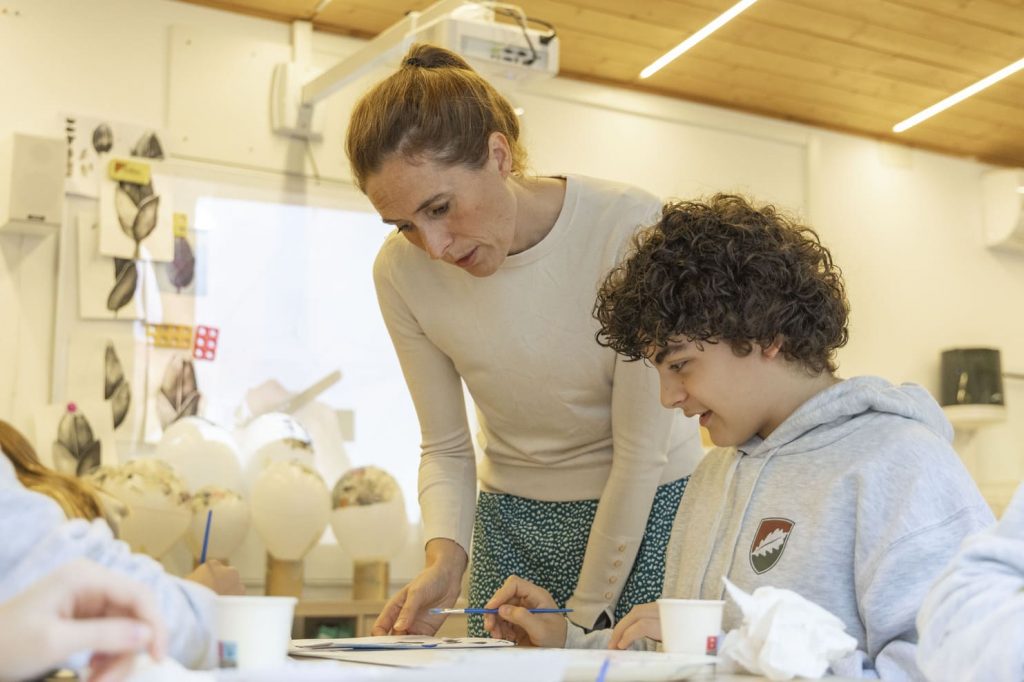
What is EYFS?
EYFS represents the first stage of the curriculum británico and covers Nursery and Reception. Its purpose is not to accelerate academic content, but to ensure balanced development across key areas of learning.
This framework recognises that young children learn best through active, hands-on experiences adapted to their individual pace.
It is built around four guiding principles:
- Every child is unique.
- Positive relationships are fundamental.
- The environment plays a central role in learning.
- Children develop and learn in different ways.

Areas of learning in the British curriculum
The EYFS framework is structured around seven areas of learning, divided into prime and specific areas.
Prime areas
- Communication and Language
- Physical Development
- Personal, Social and Emotional development
These are prioritised because they underpin all future learning.
Specific areas
- Literacy
- Mathematics
- Understanding the world
- Expressive arts and design
Learning is not compartmentalised. Instead, children explore these areas through play, investigation and guided discovery.
How is the British curriculum implemented in the classroom?
A defining feature of the British curriculum in early years is experiential learning.
Children learn through:
- Structured and free play
- Thematic projects
- Exploration of their environment
- Practical, hands-on activities
- Continuous adult interaction and guidance
Assessment is based on observation and progress tracking rather than formal examinations.
Assessment in the EYFS is not based on tests, but on the ongoing observation of a child’s progress across different areas.
The benefits of EYFS
The British early years approach:
- Encourages independence from an early age
- Builds confidence and initiative
- Strengthens oral communication
- Promotes curiosity and creativity
- Lays the foundation for critical thinking
As part of the British education system, EYFS ensures academic continuity into later stages such as IGCSE and A Levels.
A child-centered approach to learning
The British curriculum in Early Years places the child at the center of the educational process. Not all children learn at the same pace or in the same way.
For this reason, individualized observation and pedagogical adaptation are essential. The goal is for each student to develop confidence, motivation, and a desire to learn.
Building strong foundations
The goal of the British curriculum in early years is not to rush children into primary content, but to establish strong foundations in language, emotional regulation, social skills and logical thinking.
When these foundations are secure, future academic progression becomes natural and sustainable.
Because long-term success begins with a respectful, stimulating and well-guided start.